A decision should be explainable—and revisable.
Strong decisions begin with clear questions, reliable evidence, and a willingness to challenge assumptions. SYNKRAM uses a five-stage approach—Define, Inspect, Model, Challenge, and Transfer—to turn complex business questions into structured analysis and actionable insights.

A practical example: Hire, contract capacity, or defer?
Consider a project-based business experiencing increasing demand. Should it hire additional employees, engage outside contractors, or delay expanding capacity? This illustrative scenario follows the same business decision through each of the five stages, demonstrating how evidence, financial analysis, and operational considerations contribute to a well-grounded recommendation. Illustrative scenario, not a client case study.

STAGE 01 — DEFINE
Define: What decision are we actually making?
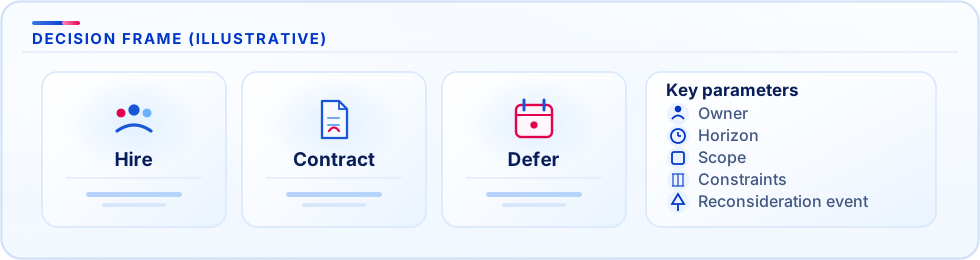
Every meaningful analysis begins with a clearly defined decision. Before examining financial models or performance metrics, we establish the underlying business question, available alternatives, decision-makers, relevant constraints, and desired outcomes.
In our capacity-planning example, the business must decide whether to hire, contract additional support, or defer expansion. We begin by identifying demand expectations, delivery requirements, budget limitations, cash flow considerations, and the time available to make the decision. The result is a clearly established decision framework that guides the analysis that follows.
STAGE 02 — INSPECT
Inspect: Can the evidence support the decision?
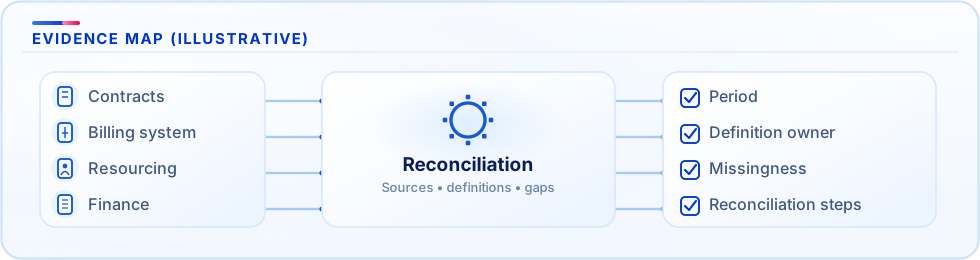
Reliable analysis depends on reliable information. We examine the underlying data, understand how key figures are calculated, reconcile inconsistencies, and identify gaps that could affect the outcome.
For the capacity decision, this means distinguishing confirmed contracts from potential opportunities, invoiced revenue from collected cash, and total workforce capacity from actual available hours. This process establishes which information can support the analysis, which assumptions require further investigation, and where uncertainty remains.
STAGE 03 — MODEL
Model: Make the alternatives comparable.
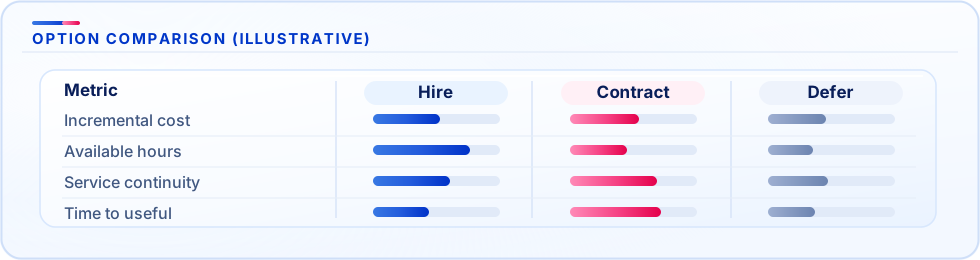
Once the evidence has been assessed, we translate the available options into a structured analytical framework. Each alternative is evaluated using consistent assumptions, comparable time horizons, and relevant financial and operational measures.
In our example, hiring introduces ongoing employment costs, contracting provides additional flexibility with different cost and availability considerations, and deferring preserves resources while potentially delaying growth. By examining capacity, costs, cash flow, implementation timelines, and service continuity together, we develop a clearer understanding of the tradeoffs involved.
STAGE 04 — CHALLENGE
Challenge: Test the assumptions before making the decision.
A useful model should withstand scrutiny. We examine how changes in key assumptions could influence the outcome, identify vulnerabilities, and consider alternatives that challenge the initial conclusions.
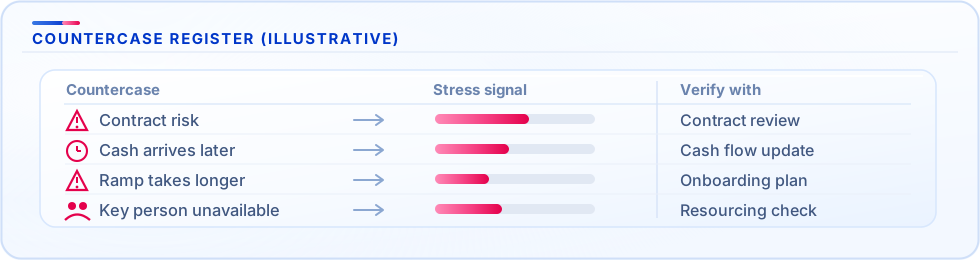
What happens if customer demand grows more slowly than expected? What if a major contract is delayed, labor costs increase, or additional resources take longer to become productive? Through scenario analysis and sensitivity testing, we identify the factors that matter most and distinguish conclusions that remain reliable from those that depend on uncertain conditions.
STAGE 05 — TRANSFER
Transfer: Turn analysis into actionable next steps.
The purpose of analysis is not simply to produce a result. It is to give decision-makers a clear understanding of the available choices, the reasoning behind the recommendations, and the actions required to move forward.
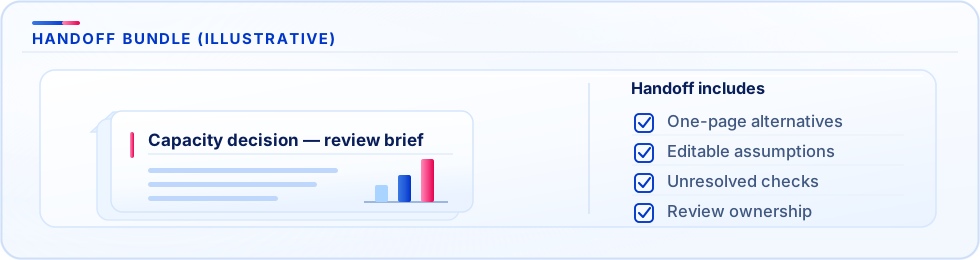
We bring together the evidence, assumptions, financial implications, operational considerations, and outstanding uncertainties into a structured decision framework. For the capacity-planning example, the final output would compare hiring, contracting, and deferring, explain the conditions under which each option is preferable, and identify the next steps and responsibilities needed to support implementation. The result is analysis that can be understood, communicated, revisited, and used to guide decisions.