
CORPORATE PROJECT FEASIBILITY

Evaluate the choice—not just the projected return.

Expansion, equipment, outsourcing and other investments compete for limited capital and capacity. We help businesses compare alternatives, test critical assumptions and understand the financial and operational tradeoffs before making a commitment.

THE BUSINESS DECISION

Begin with the alternatives

Illustrative project scenario

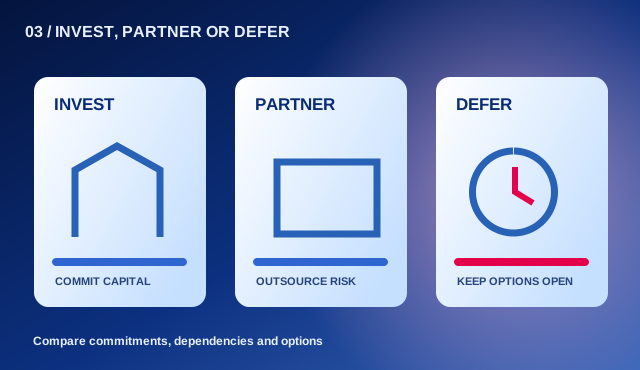
Consider a manufacturer facing increased demand. It can buy equipment, rely on external production, or defer expansion. None of those choices is automatically best: each has different financial commitments, operating dependencies and risks.

OPTION A

Own equipment

Higher upfront investment with greater potential control of long-run capacity.

OPTION B

Use a provider

Less fixed capital, but greater exposure to supplier pricing and availability.

OPTION C

Defer investment

Preserve flexibility while accepting possible capacity or growth constraints.
DECISION MATRIX

Compare the options on equal terms

Illustrative decision matrix — not actual client results
AlternativeEvidence to verifyKey downsideDecision condition
Own equipmentInstallation cost, demand, maintenance, ramp-upCommissioning delays or low utilizationProceed after engineering and demand review.
External providerContracted capacity, unit cost, qualityUnavailable slots or rising pricesCompare flexibility with supplier dependency.
DeferCurrent capacity, opportunity costsLost orders or customer delaysReassess at a defined evidence milestone.

The comparison uses the same evaluation horizon and separates directly incremental cash flows from sunk costs. Where reliable inputs exist, a sensitivity analysis can clarify break-even conditions or investment economics.

EVIDENCE & RISK

Follow the investment logic

Diagram illustrating investment alternatives and operating dependencies

Capital requirements

Upfront funding, working capital and ongoing obligations.

Execution feasibility

Physical capacity, staffing, approvals and dependencies.

Sensitivity to change

Demand, timing, costs and conditions that could reverse the decision.

NEXT STEPS

Deliver a decision that can be revisited

A useful evaluation captures alternatives, assumptions, uncertainties, financial implications and conditions for revisiting the choice. Engineering, regulatory and specialist approvals remain with the appropriate qualified professionals.

The goal

A transparent basis for a responsible investment decision—not an impressive number detached from operational realities.

THE NEXT QUESTION

Which assumption could change your investment decision?

Bring us the decision you're facing. We can help identify the relevant evidence, compare practical options, and establish clear next steps.

Discuss your project